Footage accessed by The Wire has once again exposed how religious extremism, backed by impunity, is turning moments of personal grief into flashpoints of communal violence. In Badetevda village in Kanker district, Chhattisgarh, a Christian family’s attempt to bury their dead escalated into mob violence, arson and the targeting of an entire religious community—pointing to the growing reach of Hindu extremist groups in rural India.
On December 15, Rajman Salam, the elected sarpanch of Badetevda village, took his 70-year-old ailing father, Chamra Ram Salam, to the district hospital in Kanker, where he passed away within hours. Although Rajman had converted to Christianity many years ago, he initially wanted to cremate his father according to local Hindu customs. However, he said he was denied the right to perform these rituals because of his Christian faith.
The following day, December 16, the Salam family decided to bury Chamra Ram according to Christian rites on their private land. Rajman said that locals soon objected to the burial, leading to a verbal dispute that escalated rapidly. According to him, once Hindutva groups such as the Rashtriya Swayamsevak Sangh and the Bajrang Dal became involved, the burial ceremony was forcibly stopped and the argument turned into a physical confrontation. Several of Rajman’s family members and friends were injured in the clash.
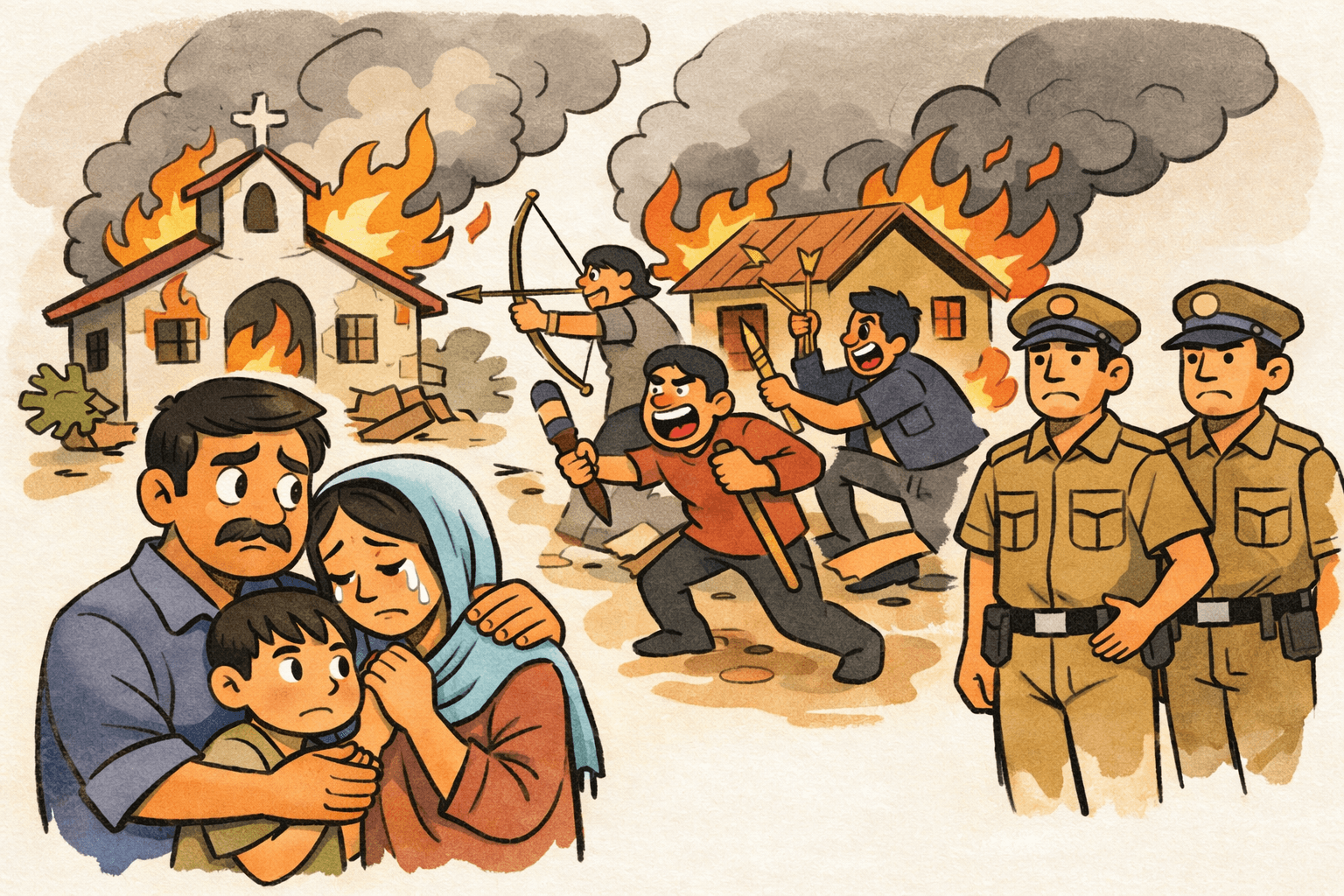
Rajman alleged that instead of stopping the mob, the police began pressuring his family to withdraw. He claimed that the police only intervened seriously when their own personnel were assaulted. Video footage from the village shows angry mobs vandalising Christian homes and prayer halls with bamboo sticks and setting properties on fire, even in the presence of law enforcement officials.
According to a police note, some villagers expressed suspicion about the circumstances surrounding Chamra Ram Salam’s death and objected to the burial, claiming it was not conducted according to “traditional tribal customs.” Acting on these complaints, an Executive Magistrate issued an order on December 18 for the exhumation of the body for post-mortem examination. The body was exhumed the same day, following persistent protests.
Soon after the exhumation, violence spread through Badetevda village. Churches and Christian homes were attacked and set ablaze. Rajman alleged that his house was burned and that the administration failed to act swiftly enough to prevent the attacks. A local journalist confirmed that these incidents were captured on camera and occurred despite police presence.
Police officials later stated that clashes among villagers led to stone-pelting and property damage, with over 20 police personnel injured during the unrest. While an FIR was registered, authorities did not clearly specify the charges or the extent of damage to Christian property. Senior police and administrative officials were deployed to the area, and the situation was declared under control.
Rajman said that his family is willing to compromise and rebury his father according to local traditions, but only if they are allowed to be present. “Everybody should be allowed to bury their dead,” he said.
A press release from the United Christian Forum described the incident as part of a broader pattern of burial-related violence targeting Christians. The group noted that such disputes are becoming increasingly politicised, with grieving families facing mob violence, forced exhumations and coercion. The Forum recorded 23 burial-related incidents in 2025 so far, most of them in Chhattisgarh, highlighting how religious extremism is intruding even into matters of death and mourning.
At its core, the Badetevda incident reflects how Hindu extremism operates not only through political rhetoric but through control over the most intimate aspects of life—and death—while state protection for minority rights continues to weaken.
On December 15, Rajman Salam, the elected sarpanch of Badetevda village, took his 70-year-old ailing father, Chamra Ram Salam, to the district hospital in Kanker, where he passed away within hours. Although Rajman had converted to Christianity many years ago, he initially wanted to cremate his father according to local Hindu customs. However, he said he was denied the right to perform these rituals because of his Christian faith.
The following day, December 16, the Salam family decided to bury Chamra Ram according to Christian rites on their private land. Rajman said that locals soon objected to the burial, leading to a verbal dispute that escalated rapidly. According to him, once Hindutva groups such as the Rashtriya Swayamsevak Sangh and the Bajrang Dal became involved, the burial ceremony was forcibly stopped and the argument turned into a physical confrontation. Several of Rajman’s family members and friends were injured in the clash.
Rajman alleged that instead of stopping the mob, the police began pressuring his family to withdraw. He claimed that the police only intervened seriously when their own personnel were assaulted. Video footage from the village shows angry mobs vandalising Christian homes and prayer halls with bamboo sticks and setting properties on fire, even in the presence of law enforcement officials.
According to a police note, some villagers expressed suspicion about the circumstances surrounding Chamra Ram Salam’s death and objected to the burial, claiming it was not conducted according to “traditional tribal customs.” Acting on these complaints, an Executive Magistrate issued an order on December 18 for the exhumation of the body for post-mortem examination. The body was exhumed the same day, following persistent protests.
Soon after the exhumation, violence spread through Badetevda village. Churches and Christian homes were attacked and set ablaze. Rajman alleged that his house was burned and that the administration failed to act swiftly enough to prevent the attacks. A local journalist confirmed that these incidents were captured on camera and occurred despite police presence.
Police officials later stated that clashes among villagers led to stone-pelting and property damage, with over 20 police personnel injured during the unrest. While an FIR was registered, authorities did not clearly specify the charges or the extent of damage to Christian property. Senior police and administrative officials were deployed to the area, and the situation was declared under control.
Rajman said that his family is willing to compromise and rebury his father according to local traditions, but only if they are allowed to be present. “Everybody should be allowed to bury their dead,” he said.
A press release from the United Christian Forum described the incident as part of a broader pattern of burial-related violence targeting Christians. The group noted that such disputes are becoming increasingly politicised, with grieving families facing mob violence, forced exhumations and coercion. The Forum recorded 23 burial-related incidents in 2025 so far, most of them in Chhattisgarh, highlighting how religious extremism is intruding even into matters of death and mourning.
At its core, the Badetevda incident reflects how Hindu extremism operates not only through political rhetoric but through control over the most intimate aspects of life—and death—while state protection for minority rights continues to weaken.