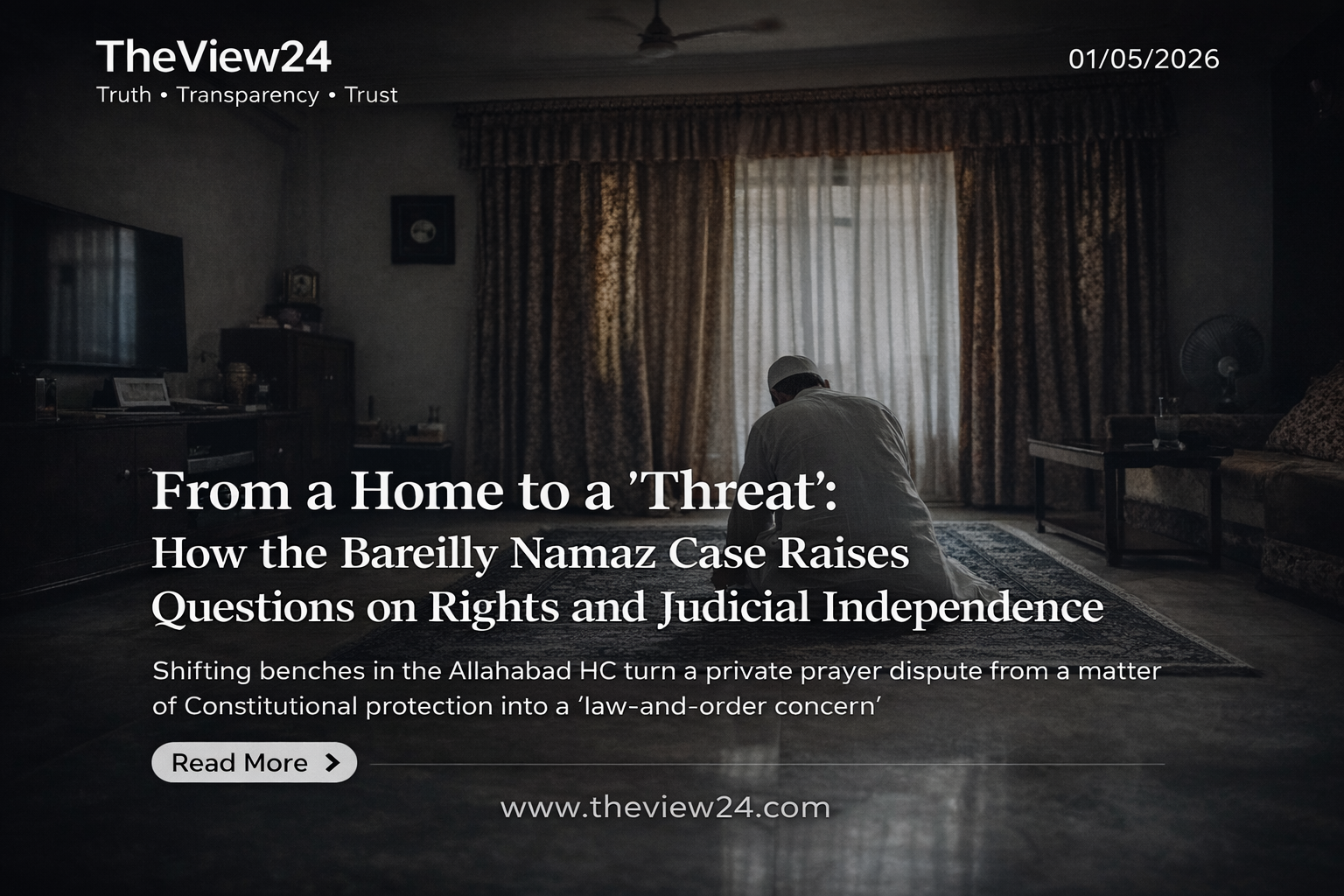
+The Bareilly namaz case did not begin in a park, a street, or a public square. It began inside a home. A Muslim man approached the court alleging that he was being prevented from offering namaz within his own private property—a space that, under the Constitution, should represent the most secure zone for personal liberty and religious freedom.
What followed, however, was not a straightforward affirmation of that right, but a legal journey that reveals something far more unsettling: how even the most basic exercise of faith can become contingent on judicial interpretation—and how that interpretation can shift dramatically with a change of bench.
An earlier bench of the Allahabad High Court made a clear and constitutionally grounded observation: no permission from the state is required to offer prayers within private premises. This was not a radical position—it flows directly from Article 25, which guarantees the freedom to practice religion. The court went further, taking the allegations seriously enough to issue contempt notices against district officials and even granting the petitioner police protection, recognising the possibility of coercion and intimidation.
At that moment, the case seemed to reaffirm a fundamental principle: that the home is inviolable, and that religious freedom within it does not require negotiation with the state or society.
Then came a change in the bench.
With the roster altered, the tone and direction of the case shifted. The new bench disposed of the petition after recording an undertaking from the petitioner that he would not allow “large gatherings” for namaz at the property. It also withdrew the security that had earlier been granted and discharged the contempt proceedings against officials.
The reasoning rested on a familiar but expansive ground: public order. The state argued that 50–60 people were regularly offering namaz at the property, and that such gatherings could disturb peace. The court accepted this concern, allowing authorities to act if such gatherings continued.
What emerges here is not merely a modification of conditions, but a transformation of the case itself.
The same set of facts—people offering namaz inside a private home—was first treated as a matter of constitutional protection, and then as a matter of potential law-and-order concern. The same Constitution, the same right, the same space—but a different outcome.
This raises a fundamental question: are rights stable guarantees, or are they shaped—and reshaped—by the judge hearing the case?
But the shift also opens up another, more institutional concern: what does such a stark change say about the independence and consistency of the judiciary itself?
Judicial independence is not only about freedom from executive interference. It is also about consistency, coherence, and the assurance that constitutional principles will not fluctuate sharply with changes in bench composition. When two benches, within the same court, interpret the same facts so differently—one expanding protection, the other narrowing it—it raises concerns about whether outcomes are becoming overly dependent on individual judicial outlooks.
This does not necessarily imply direct external influence. But it does point to a deeper issue: the growing perception that justice may vary not just by law, but by who interprets it. And perception, in matters of justice, is not trivial—it shapes public trust.
The Constitution is unambiguous in principle. The right to practice religion is subject to public order, but that limitation has traditionally been applied to activities in public spaces. Extending that logic into private homes marks a significant shift. It suggests that even within one’s own property, the exercise of faith can be curtailed if it is perceived—however broadly—to affect others.
But perception is not a neutral standard. It is shaped by context, by identity, and often by majoritarian comfort.
In Bareilly, the concern was not that prayers were spilling onto public roads, but that a number of people had gathered within a private space. This raises an uncomfortable comparison: religious gatherings of similar scale within private premises are not uncommon across communities. Yet, they do not always attract the same level of scrutiny or restriction.
The shift in judicial approach also highlights something deeper about the nature of constitutional rights in practice. While they are framed as universal and inalienable, their enforcement depends on interpretation. And when that interpretation varies significantly between benches, it introduces an element of unpredictability.
For minorities, this unpredictability is not abstract—it is lived. It means that the ability to exercise a fundamental right may depend not just on the Constitution, but on which bench hears the case, how the facts are framed, and how “public order” is interpreted in that moment.
The Bareilly case, then, is not just about namaz. It is also about the fragility of institutional confidence when judicial outcomes shift so sharply. It raises concerns not only about rights, but about the stability of the system meant to protect them.
And it leaves behind a question that goes to the heart of constitutional democracy: If the right to pray in one’s own home can first be defended as absolute, and then limited as conditional—and if that shift follows a change in bench—what does that say about the certainty of both rights and institutions?
Because a fundamental right that changes with the judge risks becoming something else entirely—not a right, but a permission.
What followed, however, was not a straightforward affirmation of that right, but a legal journey that reveals something far more unsettling: how even the most basic exercise of faith can become contingent on judicial interpretation—and how that interpretation can shift dramatically with a change of bench.
An earlier bench of the Allahabad High Court made a clear and constitutionally grounded observation: no permission from the state is required to offer prayers within private premises. This was not a radical position—it flows directly from Article 25, which guarantees the freedom to practice religion. The court went further, taking the allegations seriously enough to issue contempt notices against district officials and even granting the petitioner police protection, recognising the possibility of coercion and intimidation.
At that moment, the case seemed to reaffirm a fundamental principle: that the home is inviolable, and that religious freedom within it does not require negotiation with the state or society.
Then came a change in the bench.
With the roster altered, the tone and direction of the case shifted. The new bench disposed of the petition after recording an undertaking from the petitioner that he would not allow “large gatherings” for namaz at the property. It also withdrew the security that had earlier been granted and discharged the contempt proceedings against officials.
The reasoning rested on a familiar but expansive ground: public order. The state argued that 50–60 people were regularly offering namaz at the property, and that such gatherings could disturb peace. The court accepted this concern, allowing authorities to act if such gatherings continued.
What emerges here is not merely a modification of conditions, but a transformation of the case itself.
The same set of facts—people offering namaz inside a private home—was first treated as a matter of constitutional protection, and then as a matter of potential law-and-order concern. The same Constitution, the same right, the same space—but a different outcome.
This raises a fundamental question: are rights stable guarantees, or are they shaped—and reshaped—by the judge hearing the case?
But the shift also opens up another, more institutional concern: what does such a stark change say about the independence and consistency of the judiciary itself?
Judicial independence is not only about freedom from executive interference. It is also about consistency, coherence, and the assurance that constitutional principles will not fluctuate sharply with changes in bench composition. When two benches, within the same court, interpret the same facts so differently—one expanding protection, the other narrowing it—it raises concerns about whether outcomes are becoming overly dependent on individual judicial outlooks.
This does not necessarily imply direct external influence. But it does point to a deeper issue: the growing perception that justice may vary not just by law, but by who interprets it. And perception, in matters of justice, is not trivial—it shapes public trust.
The Constitution is unambiguous in principle. The right to practice religion is subject to public order, but that limitation has traditionally been applied to activities in public spaces. Extending that logic into private homes marks a significant shift. It suggests that even within one’s own property, the exercise of faith can be curtailed if it is perceived—however broadly—to affect others.
But perception is not a neutral standard. It is shaped by context, by identity, and often by majoritarian comfort.
In Bareilly, the concern was not that prayers were spilling onto public roads, but that a number of people had gathered within a private space. This raises an uncomfortable comparison: religious gatherings of similar scale within private premises are not uncommon across communities. Yet, they do not always attract the same level of scrutiny or restriction.
The shift in judicial approach also highlights something deeper about the nature of constitutional rights in practice. While they are framed as universal and inalienable, their enforcement depends on interpretation. And when that interpretation varies significantly between benches, it introduces an element of unpredictability.
For minorities, this unpredictability is not abstract—it is lived. It means that the ability to exercise a fundamental right may depend not just on the Constitution, but on which bench hears the case, how the facts are framed, and how “public order” is interpreted in that moment.
The Bareilly case, then, is not just about namaz. It is also about the fragility of institutional confidence when judicial outcomes shift so sharply. It raises concerns not only about rights, but about the stability of the system meant to protect them.
And it leaves behind a question that goes to the heart of constitutional democracy: If the right to pray in one’s own home can first be defended as absolute, and then limited as conditional—and if that shift follows a change in bench—what does that say about the certainty of both rights and institutions?
Because a fundamental right that changes with the judge risks becoming something else entirely—not a right, but a permission.