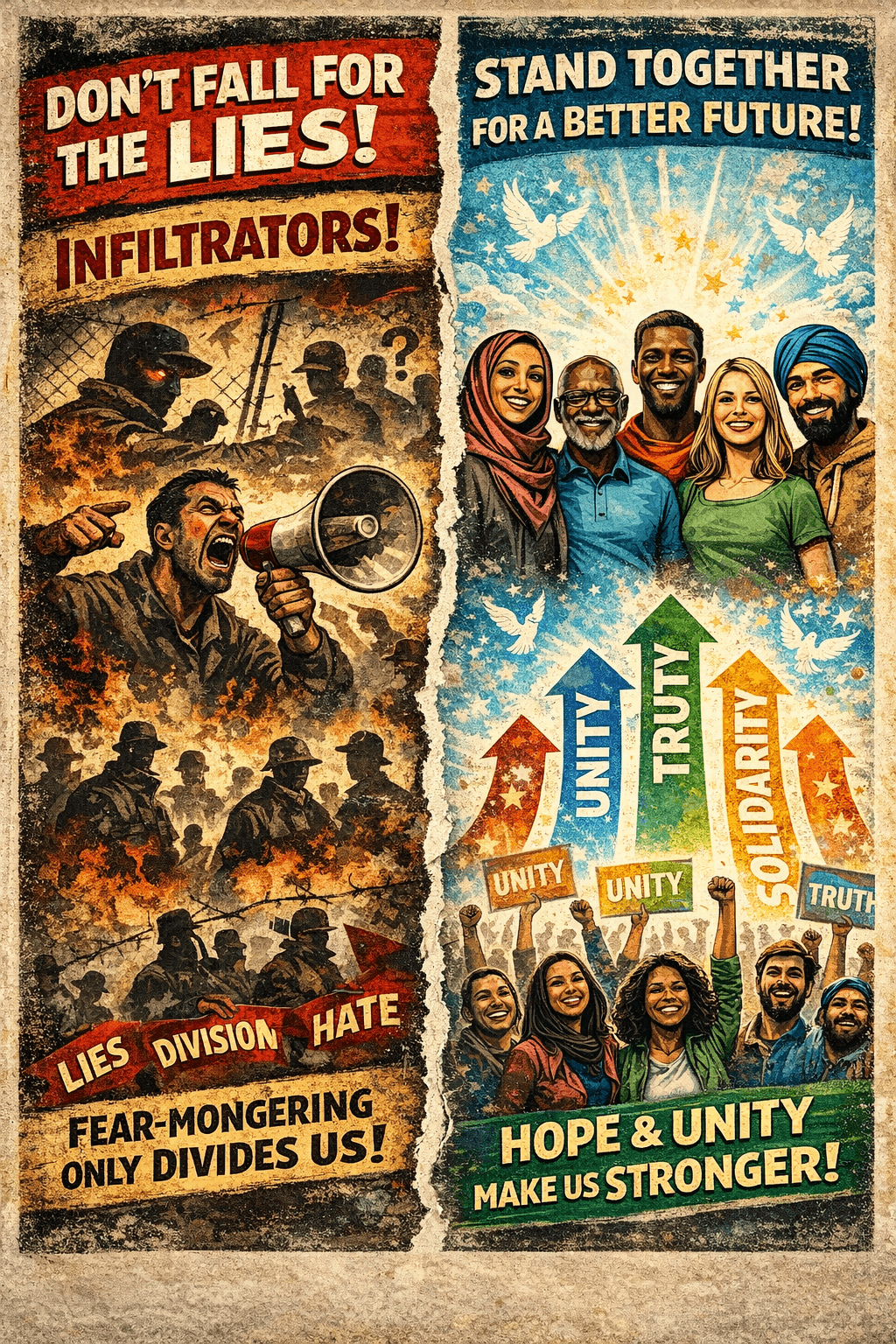
The repeated use of the term “infiltrator” by leaders of the Bharatiya Janata Party, including prominent speeches by Amit Shah, is not merely a matter of political rhetoric.
It is part of a larger narrative—one that risks redefining the very boundaries of belonging.
Language in politics is never neutral.
Words do more than describe reality; they shape it.
When those in power consistently invoke terms that portray certain groups as outsiders, illegal, or suspect, they are not simply identifying a problem—they are constructing one.
In contemporary India, this construction increasingly blurs the distinction between undocumented migrants and Indian Muslims as a broader community.
This process is gradual but powerful.
It begins with rhetoric—sharp, simplified, and emotionally charged.
Terms like “infiltrator” are repeated across speeches, interviews, and campaign platforms.
Then comes amplification.
Television debates echo it.
Social media multiplies it.
Messaging apps distort and intensify it.
What starts as a political phrase soon hardens into a social label.
And labels carry consequences.
When a community is persistently associated with illegitimacy, suspicion inevitably follows.
That suspicion does not remain confined to public discourse; it seeps into everyday life—into bureaucratic processes, policing practices, and interpersonal interactions.
This is not hypothetical—history offers repeated examples of how identity-based rhetoric reshapes societies when left unchecked.
The most concerning aspect is the perception that institutions meant to act as safeguards are either silent or ineffective.
When media scrutiny weakens, when administrative actions appear uneven, and when accountability mechanisms seem distant or delayed,
it creates an environment where power operates with fewer constraints.
Whether this results from coordination or systemic inertia is debated—but for those affected, the outcome feels the same.
Consider the case of Sunali Khatoon.
According to her account, she was detained, allegedly tortured, and forcibly pushed across the border into Bangladesh—all while pregnant.
If true, this represents not merely a bureaucratic lapse, but a profound human rights failure.
Yet such cases rarely remain at the center of national attention.
They surface briefly, only to be overshadowed by louder narratives that justify suspicion rather than interrogate it.
That silence is revealing.
When incidents like these fail to provoke sustained public outrage, it signals a deeper shift:
the normalization of unequal treatment.
It suggests a growing acceptance that some identities are more contestable than others—that certain citizens must bear a heavier burden of proof to assert their belonging.
This is how erosion occurs—not suddenly, but cumulatively.
Supporters of the government argue that the term “infiltrator” is directed strictly at illegal immigration, not at any religious community.
On paper, that distinction matters.
But politics does not operate on intent alone; it operates through perception, repetition, and impact.
If a narrative is consistently received as targeting a particular community, its effects cannot be dismissed by clarifying its original intent.
What is ultimately at stake is not just a debate over terminology—it is the meaning of citizenship itself.
The Indian Constitution does not recognize degrees of belonging based on religion.
It does not leave room for ambiguity about who deserves to live in the country.
Yet when public discourse begins to imply otherwise—even indirectly,
it creates a growing disconnect between constitutional principles and lived reality.
This is where rhetoric becomes risk.
When citizens feel compelled to constantly prove their legitimacy, the foundation beneath them becomes unstable.
Rights begin to feel conditional.
Identity turns into a vulnerability.
And in that uncertainty, a quiet but persistent fear takes hold.
India has long taken pride in its pluralism—in its ability to hold multiple identities within a single democratic framework.
That promise is rarely broken in a single moment;
it is gradually worn down through the normalization of exclusionary language and the absence of meaningful challenge to it.
The question, then, is not whether rhetoric matters.
The real question is whether a democracy can afford to ignore what that rhetoric sets in motion.